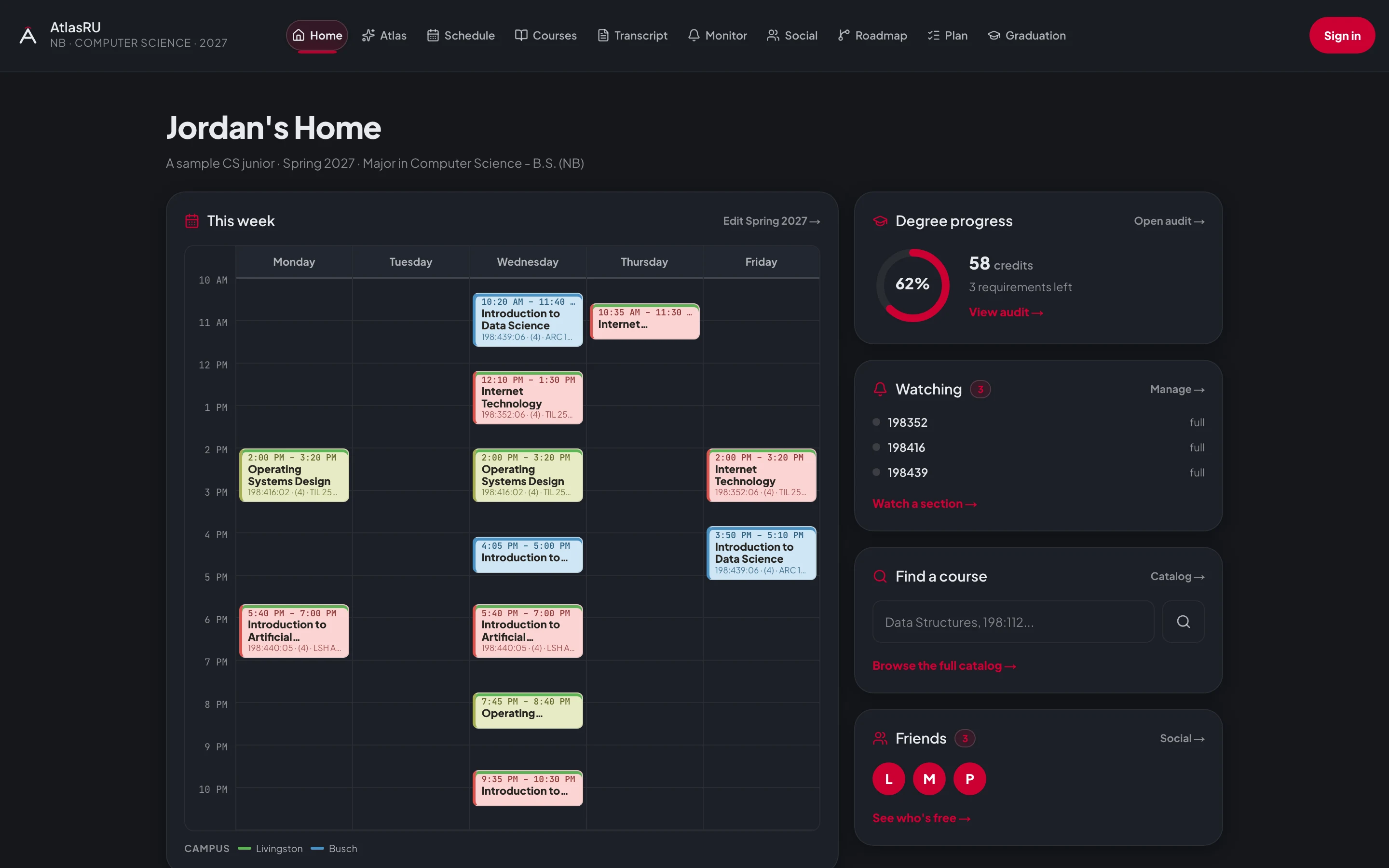
AtlasRU is a course planner for Rutgers students. It puts schedule building, live seat counts, seat alerts, a degree audit and an AI advisor in one place. It went live in June 2026, and about 1,190 people visited it between July and October. I built it alone and I still run it, which means I also answer the support email and pay the hosting bill.
When I started, I thought the hard part would be building features. It wasn't. The hard part was a kind of failure I hadn't learned to look for: everything seems to work, nothing shows an error, and the answer is still wrong. This page goes through the times that happened, what I believed then, what was really going on, and what I'd tell someone else to take from it.
Where it started
AtlasRU began at Middlesex College with a professor I picked badly. Their overall rating was good, so I signed up. What the average hid was that students loved them in intro Java and rated them much lower in the online course I was actually taking.
So in October 2025 I built the view I'd wanted: a small site that pulled professor reviews and kept them separate by course and by in-person or online. A Middlesex club used the first version.11. Before I made that project's code public, I rebuilt its history from scratch, because an old version still contained a password. Deleting a file later doesn't remove it from a project's history. The reviews were the same ones anyone could read. Organizing them differently is what let the site answer the question students were actually asking, and I still think about how data is organized before I think about features because of it.
At Rutgers the problem was bigger. Registering means juggling several university systems and usually a spreadsheet. I started with a small script in March 2026 and rebuilt it twice. The last rebuild was the one that mattered: the schedule builder, the seat alerts and the degree audit all had to agree on basic things like what counts as a course, and a few loosely connected scripts couldn't keep that consistent.
Why a seat poll filled half the database
Seat alerts are the feature most people sign up for. AtlasRU checks Rutgers every couple of seconds and emails you when a seat opens in a class you're watching. My first version saved every watched class's status back to the database on every check, even when nothing had changed. I assumed that was harmless, since saving the same value again doesn't change anything.
It wasn't harmless. The database keeps an old copy behind every time something is saved, and a background job is supposed to clean those copies up. Saving every class every few seconds was creating millions of leftover copies a day. On its own that would have been wasteful but manageable. What made it a real problem was a backup I'd started from my laptop: the connection dropped, but the backup kept running on the server for about two days, and while it ran, the cleanup job couldn't remove anything. By the time I noticed, while looking into why my hosting bill had grown, one small feature was taking up about half the database, and backups had been failing for days.
Try it below. Switch between saving every class and saving only the ones that changed, and see how the amount of work changes.
One tick every 2 seconds is 43,200 ticks a day. At 79 rows, writing every row is 3,412,800 writes.
The fix was simple: only save a class when its status actually changes. I also stopped the stuck backup and put a time limit on backups so one can't hang around like that again. Afterwards the database went back to its normal size and its workload dropped to almost nothing. I checked that by watching it for a while rather than assuming the fix worked, including making sure the seat checks were still running.
At the time I told myself no test could have caught this, because the data was always correct. That isn't quite true. A test that only checks the result would have passed, but a test that checked how much work happens when nothing has changed would have failed. I just wasn't thinking of cost as something you can test. Now, for anything that runs on a timer, I ask what it does when nothing has changed, because that's what it's doing almost all of the time.
When a failed read looks like an answer
Several of AtlasRU's worst bugs had the same shape: the app couldn't tell the difference between "I checked and there's nothing" and "I couldn't check".
Seat data is the clearest example. If Rutgers' site is down and the app records that as "zero open seats", every decision after that, including whether to email someone, is based on something false, and nothing looks broken. Now a failed check is recorded as a failed check, and when Rutgers returns an empty response during maintenance, AtlasRU ignores it instead of marking every class closed.
The same thing happened with links to the campus map. They opened the map and looked fine in testing, but the map quietly ignored which building I asked for. I switched to a Rutgers classroom page that shows an error for a room it doesn't recognize. That sounds worse, but it's better: because the page can say no, I could check every room AtlasRU links to and know each one works.
Sean Goedecke argues in 'Make invalid states unrepresentable' considered harmful that software should be more flexible than strict rules about what's allowed. I agree, and I don't think it conflicts with this. Letting the app say "I don't know" doesn't make it stricter, it makes it more honest. Where I draw the line is what people decide based on it: a missing professor rating can just say N/A, but a missing seat count can't quietly turn into zero.
How the audit marked unfinished requirements done
The degree audit reads your transcript and tells you which graduation requirements you've finished. It can be wrong in two ways, and they aren't equally bad. Telling you that you still need a course you don't is annoying, and you'll probably double-check. Telling you you're done when you aren't could surprise you when you apply to graduate.
To measure it, I compared AtlasRU's audit with Degree Navigator, Rutgers' official system, one requirement at a time. One caveat applies to everything below: I used my own transcript, checked against every New Brunswick program. That shows whether AtlasRU reads requirements the way Rutgers does. It doesn't prove every student's audit is right.
The first comparison matched about 82% of the time, and the worst mismatches were requirements AtlasRU said were finished when Rutgers said they weren't. The cause was the code that reads Rutgers' written requirement descriptions. When it hit wording it didn't understand, it skipped that rule instead of failing, and a requirement with no rules left counts as finished, the same way "every item on an empty list is done" is technically true. I had expected failures to look like errors. They looked like finished requirements.
Transcript (click to change)
Rules to check
[CS 111, CS 112]With the rule skipped, no transcript can fail it: every rule in an empty list is met. Course names are illustrative.
Fixing how those descriptions were read, plus a few other fixes, brought the match up to 2,425 of 2,429 requirements. I also started counting requirements that ended up with no rules at all, because nothing else would ever point them out.
The comparison taught me something about testing too. It missed a real bug where the courses you're currently taking didn't count toward anything, because my test data was slightly tidier than what the real app stores. I only found it by trying my own imported transcript. Tests are only as good as how closely their data matches the real thing.
Why the advisor is an agent
By August, students wanted to ask questions in plain English, so I built an AI advisor. My first version simply searched Rutgers websites whenever it needed something. That was slow and expensive, and it sometimes picked up outdated pages. I replaced it with tools built on data AtlasRU already keeps up to date: course search, the degree audit, schedule building, saved plans and a library of university policies.
The bigger design question was whether the advisor should decide for itself which tools to use (an agent) or follow a fixed sequence of steps. Sean Goedecke's Build agents, not pipelines argues that agents win when you can't know in advance what information you'll need. That's the advisor's situation. To answer something like "can I still graduate on time if I drop this class?", it has to check the audit, then see what that class counted toward, then look at what else is offered, and each step depends on what the last one found.
That flexibility has a cost, and the advice it gives matters as much as anything else on the site. In one conversation the advisor looked up courses one at a time, 32 times, even though its instructions said not to. I assumed it was ignoring me. It wasn't: the tool for looking up several courses at once didn't include class times, so for a scheduling question, going one by one was the only way to get an answer. Once I gave that tool the missing information and put a hard limit on the one-at-a-time lookups, that loop went away, and a similar one showed up with two other tools, which I limited too. What I took from it is that a limit just moves a loop. What usually causes it is a tool that can't give the model what it needs.
Choosing an agent doesn't mean trusting it. Before an answer reaches a student, code checks every course it mentions against real catalog data, because instructions to a model hold most of the time, and most of the time isn't good enough for something like a prerequisite. That checker has had bugs of its own, so I treat it with the same suspicion as the model.
Why the advisor got slower while every chart improved
Over the summer I worked on making the advisor faster in all the usual ways, and every number I tracked improved. It took fewer steps per question and sent the model much less text. It still didn't feel any faster, and I couldn't tell why.
The answer was in one slow conversation that took about three minutes. Almost all of that time was the model writing, and most of what it wrote was hidden "thinking" that students never saw. My code only recorded the visible answer, so that hidden writing never showed up in any of my measurements, and it had been growing all summer.
Play with the sliders below. How much the model writes and how fast it writes change the total. How much text you send it barely does.
Writing: 187.3 s. Tools: 0.3 s. Prompt processing is left out of this model; in the measured turn it was fast and mostly cached, so the prompt slider moves nothing. The defaults (22,480 tokens at 120 tokens/s) reproduce the measured 188 s turn.
Turning the hidden thinking off by default took a simple question from about 17 seconds to under 2. It can be turned back on, and I still haven't measured how much it improves the answers. That's the honest open question.
The same lesson showed up in ordinary code. A page that lists degrees took about two and a half seconds because it loaded every degree's full requirements just to count them. Letting the database do the counting brought it to a third of a second. That matches Sean Goedecke's point in Software is slow because of bad design, not slow languages: the fix was doing less work, not doing it faster.
The fast average that hid a slow load
A student once told me AtlasRU took six or seven seconds to load. My data said typical loads took well under a second, so I believed the data. Then I found their visit in it: over eight seconds. The typical number was built mostly from people who use the site every day and already have it saved in their browser, so it could never show what a returning student's first visit felt like.
The slowest numbers were misleading in the other direction. The very worst "loads" turned out to be pages opened in background tabs, where the browser keeps the clock running until you actually look at the tab.
Now, before I trust a number, I ask whose experience could have shown up in it. Averages describe whoever shows up the most, and that's rarely the person who's having trouble.
What I would tell myself in March
In March I thought I was building a course planner. What students actually use is closer to a utility: they rely on it during the most stressful week of the semester, and it gets judged on things side projects usually skip. Backups matter. Not showing zero open seats when Rutgers' site is down matters. An advisor that won't state a prerequisite it can't check matters more than one that answers everything.
If I could send myself a note back in March, it would say three things. Treat an empty result or a zero as something to double-check, not proof that things worked. Before speeding anything up, find out what the person is actually waiting on. And when something behaves badly, look for what it can't do or can't see before adding a rule telling it to stop.
- Before I made that project's code public, I rebuilt its history from scratch, because an old version still contained a password. Deleting a file later doesn't remove it from a project's history. ↩